





Because tires play an essential role in your vehicle’s performance – and your family’s safety – their routine maintenance is essential. While it may seem simple, proper tire inflation not only helps prevent excessive wear and tear, but car accidents too. The good news is that low tire pressure can be easily remedied, saving you money on premature tire repair or replacement.
As locals’ trusted service technicians in Rock Hill, our team will handle every aspect of your car’s care! Read on to learn more about the risks of low tire pressure, then schedule your service appointment today.
Why You Shouldn’t Drive With Low Tire Pressure
Continuing to drive on underinflated or worn tires is a major risk – to both you and other drivers sharing the road. In fact, it’s one of the most common causes of vehicle collisions! According to the National Highway Traffic Safety Administration (NHTSA), about 11,000 auto accidents related to subpar tires occur annually. This statistic is particularly startling because many of these accidents could likely have been prevented by proper tire maintenance.
When tire pressure falls below recommended levels (found in your owner’s manual), more surface area comes in contact with the road. This increases the amount of friction, which in turn, causes the tire to overheat. Excessive wear, blowouts, and tread separation may follow, stranding you on the side of the road with a flat tire – or worse, causing a serious accident.
Underinflation is a top cause of tire failure, especially when low tire pressure combines with high speeds. Even if your tire doesn’t blow, your vehicle’s handling will become less responsive as the tire continues to slowly deflate. Fuel economy corresponds to pressure as well, making your vehicle less efficient as pressure drops. Plus, driving on underinflated tires will decrease their lifespan, so you’ll be paying for tire replacements before you’re due.
Tire Maintenance
Manufacturers recommend checking your tires’ pressure once a month to ensure that they are properly inflated. It’s also a good idea to check tire pressure if your vehicle has remained stationary for extended periods.
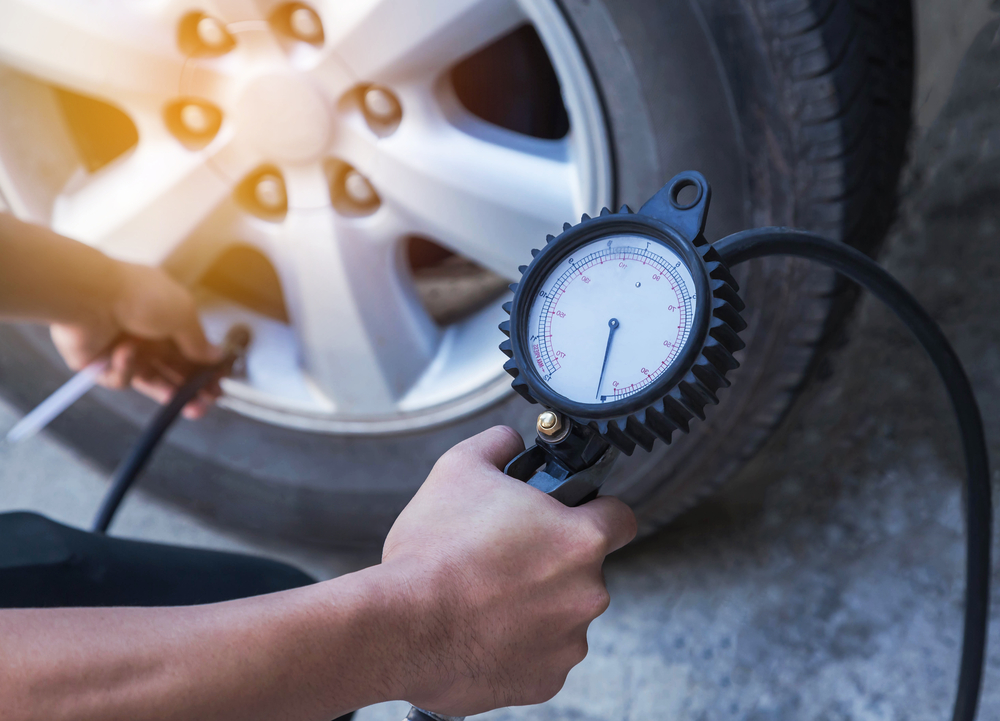
If your tire pressure light has come on or it’s time for your monthly check, all you’ll need is a tire pressure gauge, which can often be found at any gas station. Checking the pressure is easy! Just press the tire gauge against the open valve stem for a second or two before reading it. (It’s normal to hear a hiss of air.) Compare this number with the suggested tire pressure. Add air if needed, then replace the tire’s air valve cap. Be sure to prioritize your monthly pressure checks, even if you don’t suspect decreased performance or fuel efficiency.
If you drive a newer vehicle, the tire pressure monitoring system will likely display a PSI reading on your dash. Also, keep in mind that tire pressure changes with the forecast. Tire air pressure often drops when overnight temperatures do, because colder air is more dense and takes up less volume.
In addition to checking their pressure, we recommend a tire rotation every six months or so. Wheel alignments are important too, and should be performed once a year. These standard maintenance services will keep your vehicle on the road longer and help prevent costly auto repairs in the future.
Shop High-Quality Tires in Rock Hill!
Whether you need a tire repair or replacement, Burns Chevrolet can help! We’ve stocked a great selection of tires, so check out our Tire Finder Tool to start shopping today! And don’t forget to take advantage of monthly tire specials. We’ve provided some helpful resources about tire maintenance here too, including some FAQs from customers!
Our Service Department is equipped to handle all your vehicle needs, so come see us today! Conveniently located in Rock Hill, SC, we’re near Fort Mill, SC as well as Charlotte, NC. Our team is proud to serve customers throughout the Carolinas, so schedule your appointment today!
Connect with us


Recent Blog Entries
- Top 5 Features of the 2025 Chevy Equinox That Make it a Standout Choice
- Maximizing the Lifespan of Your Chevy: Maintenance Tips for Key Parts
- Top 5 Reasons to Choose a Chevy Truck for Your Next Adventure
- The 2025 Chevrolet Corvette ZR1: Exciting Updates
- Design Excellence: A Closer Look at the 2025 Chevy Malibu